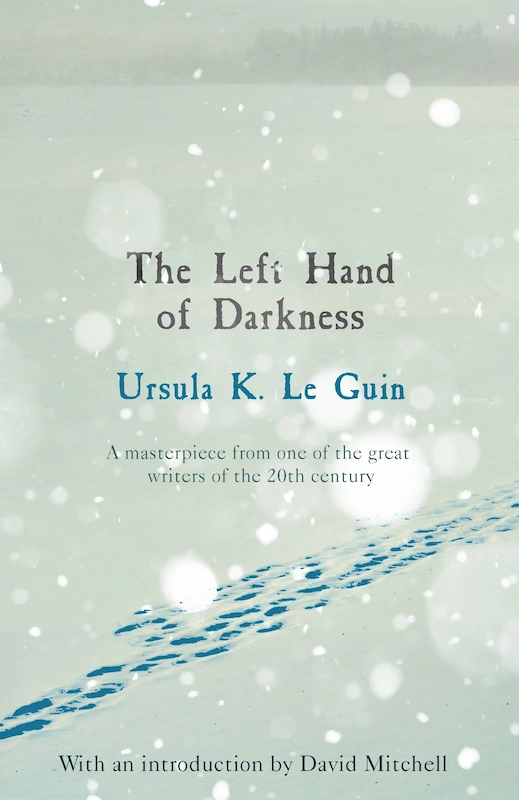
The Left Hand of Darkness
•Fiction, Science FictionWinter is an Earth-like planet with two major differences: conditions are semi artic all year round, and the inhabitants are all of the same sex. Tucked away in a remote corner of the universe, they have no knowledge of life beyond their own world. When a strange envoy from space brings news of a vast coalition of planets which they are invited to join, he is met with fear, mistrust and disbelief...
Thoughts
I’ve previously struggled to get into science fiction, as it never really appealed to me. I don’t care much for intergalactic travel or action, and growing up this seemed to be the main thing sci-fi had to offer. Obviously, I was wrong. I’ve come to realise that science fiction can be a great vehicle to explore complex issues, and that the kind of story that goes beyond “wouldn’t it be cool to race in spaceships and shoot lasers” is much more to my taste. Although, yes… it would be pretty cool.
I knew that I would enjoy The Left Hand of Darkness just by reading Ursula K. Le Guin’s introduction on the purpose of science fiction, and her relationship with it as an author.
I am not predicting, or prescribing. I am describing. I am describing certain aspects of psychological reality in the novelist’s way, which is by inventing elaborately circumstantial lies.
The story takes place in a world where everyone is androgynous. The concept of man and woman don’t exist. It is a very interesting exploration of binary sex and gender, and how they shape our lives in ways that we may not even be aware of.
The prose is beautiful and fluid. It often feels like following the narrator’s train of thought. I quite enjoyed the different perspectives offered, and how naturally the tone changed between them. That said, Le Guin does use some vocabulary that did not care for a non-native English speaker like me, and had me using a dictionary for the first time in a while. But that’s what reading is all about.
Something else that I loved about this book was the deep lore littered throughout in the form of “found media”. Ancient legends and myths from Winter (the planet the story takes place in) and notes from earlier visitors are shared with us and serve to deepen our understanding of this peculiar world. I felt very immersed by the end.
If I had to mention one thing I wish there had been more of, that’s character exposition. We get to understand a fair bit about the narrator’s personality, but not much of anything else, if that makes sense. There isn’t much about his past, or anyone else’s past. I would have liked to get to know the characters a bit better, as I felt this impacted how much I cared for their future.
This was a great read that showed me just how much my taste has changed since I stopped reading in my teens. This was also my fourth book of the year, which I know isn’t much, but it’s certainly better than zero.
Sneak peek
I underlined many passages, but below are some that spoke to me in some way, in no particular order.
And I saw then again, and for good, what I had always been afraid to see, and had pretended not to see in him: that he was a woman as well as a man. (…); what I was left with was, at last, acceptance of him as he was. Until then I had rejected him, refused him his own reality.
And I wondered, (…), what patriotism is, (…), how that yearning loyalty that had shaken my friend’s voice arises, and how so real a love can become, too often, such foolish and vile a bigotry.
He was a hard shrewd jovial politician, whose acts of kindness served his interest and whose interest was himself. His type is panhuman. I had met him on Earth, and on Hain, and on Ollul. I expect to meet him in Hell.